
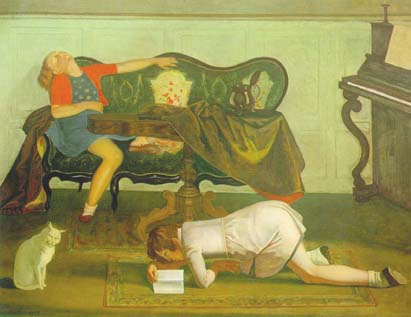
Να εξετάσουμε την αθωότητα στην ανυποψίαστη παιδική ηλικία, την διαδικασία ωρίμανσης, την διαμόρφωση του ανθρώπινου ψυχισμού, το πέρασμα μέσα απο την εφηβεία στην ωρίμανση και στον κόσμο των ενηλίκων.
Παιδικοί έρωτες αλλά και εφηβική εγκληματικότητα, εμμονές, ιδεοληψίες αλλά και επαναστατικότητα, ημερολόγια με τρυφερά ποιήματα αλλά και runaways, αποκάλυψη της σεξουαλικότητας αλλά και απόπειρες αυτοκτονίας.
Εικόνες και αναφορές για την παιδικότητα που υπάρχει στην ψυχισμό κάθε ενήλικα και στην εφηβεία που ίσως διαρκεί αιώνια. Ενα κρυφό πέρασμα αναμεσα στον κόσμο των παιδιών και τον κόσμο των ενηλίκων.
Παραμύθια, παχνίδια, περιέργεια, πρώτος έρωτας, μυθοποιημένα είδωλα, επαναστάσεις.
Μια ρευστή συναισθηματική κατάσταση
Wednesday, July 26, 2006

Friday, July 21, 2006
In the Realms of the Unreal
About Henry Darger
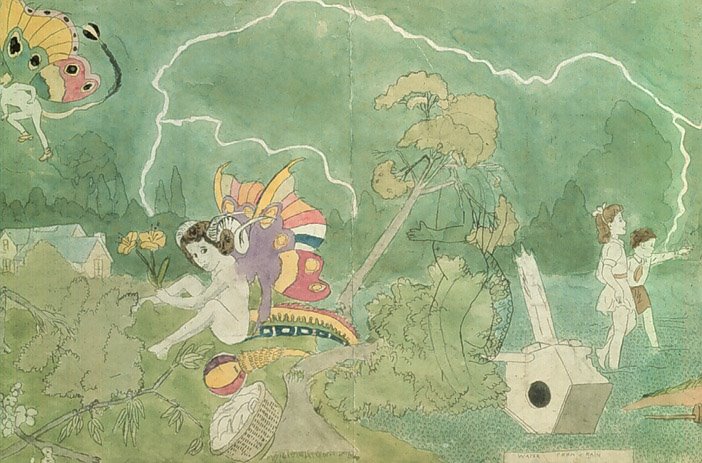
Henry Darger's landlords, the Lerners, discovered paintings in his apartment: hundreds of brilliant watercolors, some over 3m. long. The images were disturbing and mysteriously beautiful; little girls frolicking under stormy skies, little girls fighting soldiers, little girls being rescued by fantastic winged creatures.
The landlords soon found the other half of Darger’s life’s work, perhaps the longest novel ever written: the more than 15,000 page, single-spaced typed: In the Realms of the Unreal. An epic story of the virtuous Vivian girls and their religious war against the evil Glandelinian army.
His work contains many religious themes, albeit handled extremely idiosyncratically. Darger's human figures were rendered largely by tracing, collage, or photo-enlargement from popular magazines and children's books. Some of his favorite figures were the Coppertone Girl and Little Annie Rooney. The images of daring escapes, mighty battles and painful torture are reminiscent of events in Catholic history; the text makes it clear that the child victims are heroic martyrs like the early saints. One idiosyncratic feature of his artwork is an peculiar transgenderism: characters are often portrayed unclothed or partially clothed, and regardless of ostensible gender, some females have male sex organs. Some feel Darger was unfamiliar with female anatomy, that he meant it as a symbol of power or that he modeled the girls after images of the infant Jesus.
Much of the fascination with Darger concerns his portrayal of horrific brutality against children. For some reason, it is often assumed that Darger wrote and drew this way because he was enacting repressed subconscious desires. A biographer -MacGregor- claims without evidence, that Darger may have killed a girl (Paroubek), and that even if he haven't committed a crime, he "had the mind of a serial killer". It is just as likely that Darger, an abused child who had also witnessed the abuse of others, sought to reveal a truth which polite society did not wish to acknowledge.
Darger wrote also The History of My Life, a book that spends 206 pages detailing his early life before veering off into 4,672 pages of fiction about a huge twister called "Sweetie Pie," probably based on his experience at Countrybrown. He also kept a diary to chronicle the weather and his daily activities.
The sequel to Vivian Girls is called Crazy House: Further Adventures in Chicago. Begun in 1939, it is a Stephen King-like tale of a house which is possessed by demons, haunted by ghosts, or perhaps has an evil consciousness of its own, like the hotel in The Shining. Children disappear into the house and are later found brutally murdered. The Vivians and a male friend are sent to investigate and discover that the murders are the work of evil ghosts. The girls go about exorcising each room until the house is clean.
The Story of the Vivian Girls
or a 15,143-page fantasy manuscript called "The Story of the Vivian Girls, in What is known as the Realms of the Unreal, of the Glandeco-Angelinnian War Storm, Caused by the Child Slave Rebellion"
The Story of the Vivian Girls postulates a large planet around which Earth orbits as a moon and where most people are Christian. The majority of the story concerns the adventures of the daughters of Robert Vivian, seven sisters who are princesses of the Christian nation of Abbiennia, who assist a daring rebellion against a regime of child slavery imposed by the "Glandelinians". The latter resemble Confederate soldiers from the American Civil War. The children take up arms in their own defense and are often slain in battle, or after vicious torture by the Glandelinian overlords. The elaborate mythology also includes a species called the "Blengigomeneans" (Blengins), winged beings with curved horns, who are usually benevolent toward the Vivian Girls.
Through their sufferings, the Vivian Girls are to be able to bring about a triumph of Christianity. Darger provided two endings to the story: in one, the Vivian Girls and Christianity are triumphant; in the other, they are defeated and the godless Glandelinians reign.
http://www.acer-access.com/~darger@acer-access.com
http://dir.salon.com/story/books/review/2002/07/23/darger/index.html
http://dir.salon.com/story/books/review/2002/07/23/darger/index.html
Friday, July 07, 2006


Tuesday, July 04, 2006
Monday, July 03, 2006
Jungian archetypes
-The Child archetype is portrayed in literature in various ways.
It can take the form of an adult who displays child-like qualities or a young child who might give wise advice.
-The Puer Aeternus is Latin for Eternal Boy. In Jungian Analytical Psychology, examples of the puer archetype include the child, young boy or adolescent. The term can also be applicable to females in which case the Latin terminology is Puella.
Puer Aeternus: A Psychological Study of the Adult Struggle With the Paradise of Childhood and The Problem of the Puer Aeternus are books that Jungian analyst Marie-Louise von Franz wrote about a specific instance of the archetype, the puer aeternus (or "eternal youth"), which includes such figures as Peter Pan and The Little Prince in the book of the same name by Antoine de Saint-Exupéry.
Analytical psychologists claim that the puer archetype can lead to psychological problems which are manifest by immaturity, narcissism and an inabilty to develop a properly adult perspective on life.
The antithetical archetype, or enantiodromic opposite, of the puer is the senex.
from www.wikidedia.org
It can take the form of an adult who displays child-like qualities or a young child who might give wise advice.
-The Puer Aeternus is Latin for Eternal Boy. In Jungian Analytical Psychology, examples of the puer archetype include the child, young boy or adolescent. The term can also be applicable to females in which case the Latin terminology is Puella.
Puer Aeternus: A Psychological Study of the Adult Struggle With the Paradise of Childhood and The Problem of the Puer Aeternus are books that Jungian analyst Marie-Louise von Franz wrote about a specific instance of the archetype, the puer aeternus (or "eternal youth"), which includes such figures as Peter Pan and The Little Prince in the book of the same name by Antoine de Saint-Exupéry.
Analytical psychologists claim that the puer archetype can lead to psychological problems which are manifest by immaturity, narcissism and an inabilty to develop a properly adult perspective on life.
The antithetical archetype, or enantiodromic opposite, of the puer is the senex.
from www.wikidedia.org
Saturday, July 01, 2006
Thursday, June 29, 2006
Lacan on childhood
The mirror stage (le stade du miroir)
The mirror stage is described in Lacan's essay, "The Mirror Stage as formative in the function of the I as revealed in psychoanalytic experience", the first of his Écrits, which remains one of his seminal papers. Some have crudely put this as the point at which the child 'recognises' him- or herself in the mirror image, but this is unfaithful to what Lacan has in mind and also confuses his terminology. Lacan's emphasis here is on the process of identification with an outside image or entity induced through, as he puts it, "insufficiency to anticipation – and which manufactures for the subject, caught up in the lure of spatial identification, the succession of phantasies that extends from a fragmented body-image to a form of its totality that I shall call orthopaedic – and, lastly, to the assumption of the armour of an alienating identity, which will mark with its rigid structure the subject’s entire mental development" (Lacan, Écrits (rvd. edn., 2002), 'The mirror stage', p. 5).
It is significant that this process of identification is the first step towards the manufacture of the subject because all which follows it – the transition into the Imaginary and the Symbolic order (see below) – is based on this misrecognition (méconnaissance): this is the process that Lacan detects as manifesting itself at every subsequent identification with another person, identity (not to be confused with 'identification') or suchlike throughout the subject's life. This is the start of a lifelong process of identifying the self in terms of the Other. What is also occasionally overlooked (especially by those writers who accuse Lacan of outright fabrication – see below) is the experiential basis of Lacan's early paper. As one writer has observed:
"To evidence concerning the role of the other in childhood – the situation known as "transitivism," for instance, where the child will impute his own actions to another – Lacan adds evidence from animal biology, where it has been experimentally shown that a perceptual relationship to another of the same species is necessary in the normal maturing process. Without the visual presence of others, the maturing process is delayed, although it can be restored to a more nearly normal tempo by placing a mirror in the animal’s cage."
(Anthony Wilden, "Lacan and the discourse of the Other" in Lacan, The Language of the Self: the Function of Language in Psychoanalysis, trans. Anthony Wilden (London and Baltimore: Johns Hopkins University Press, 1981), pp. 159 – 160.)
The mirror stage is described in Lacan's essay, "The Mirror Stage as formative in the function of the I as revealed in psychoanalytic experience", the first of his Écrits, which remains one of his seminal papers. Some have crudely put this as the point at which the child 'recognises' him- or herself in the mirror image, but this is unfaithful to what Lacan has in mind and also confuses his terminology. Lacan's emphasis here is on the process of identification with an outside image or entity induced through, as he puts it, "insufficiency to anticipation – and which manufactures for the subject, caught up in the lure of spatial identification, the succession of phantasies that extends from a fragmented body-image to a form of its totality that I shall call orthopaedic – and, lastly, to the assumption of the armour of an alienating identity, which will mark with its rigid structure the subject’s entire mental development" (Lacan, Écrits (rvd. edn., 2002), 'The mirror stage', p. 5).
It is significant that this process of identification is the first step towards the manufacture of the subject because all which follows it – the transition into the Imaginary and the Symbolic order (see below) – is based on this misrecognition (méconnaissance): this is the process that Lacan detects as manifesting itself at every subsequent identification with another person, identity (not to be confused with 'identification') or suchlike throughout the subject's life. This is the start of a lifelong process of identifying the self in terms of the Other. What is also occasionally overlooked (especially by those writers who accuse Lacan of outright fabrication – see below) is the experiential basis of Lacan's early paper. As one writer has observed:
"To evidence concerning the role of the other in childhood – the situation known as "transitivism," for instance, where the child will impute his own actions to another – Lacan adds evidence from animal biology, where it has been experimentally shown that a perceptual relationship to another of the same species is necessary in the normal maturing process. Without the visual presence of others, the maturing process is delayed, although it can be restored to a more nearly normal tempo by placing a mirror in the animal’s cage."
(Anthony Wilden, "Lacan and the discourse of the Other" in Lacan, The Language of the Self: the Function of Language in Psychoanalysis, trans. Anthony Wilden (London and Baltimore: Johns Hopkins University Press, 1981), pp. 159 – 160.)
Monday, June 26, 2006

Friday, June 23, 2006

Subscribe to:
Posts (Atom)